On this page
The short answer
A coastal garage floor coating has five things working on it: salt in the air, wet tires and sand, sun through the open door, moisture vapor from the ground, and damp mornings during the install. A coating handles all five when it is built as a system. The concrete is diamond ground, tested for moisture and primed for it if needed, then coated with a thick base, a full flake broadcast and an aliphatic polyaspartic topcoat that holds its color in sun.
What works on a coastal garage floor
- 1
Salt in the air
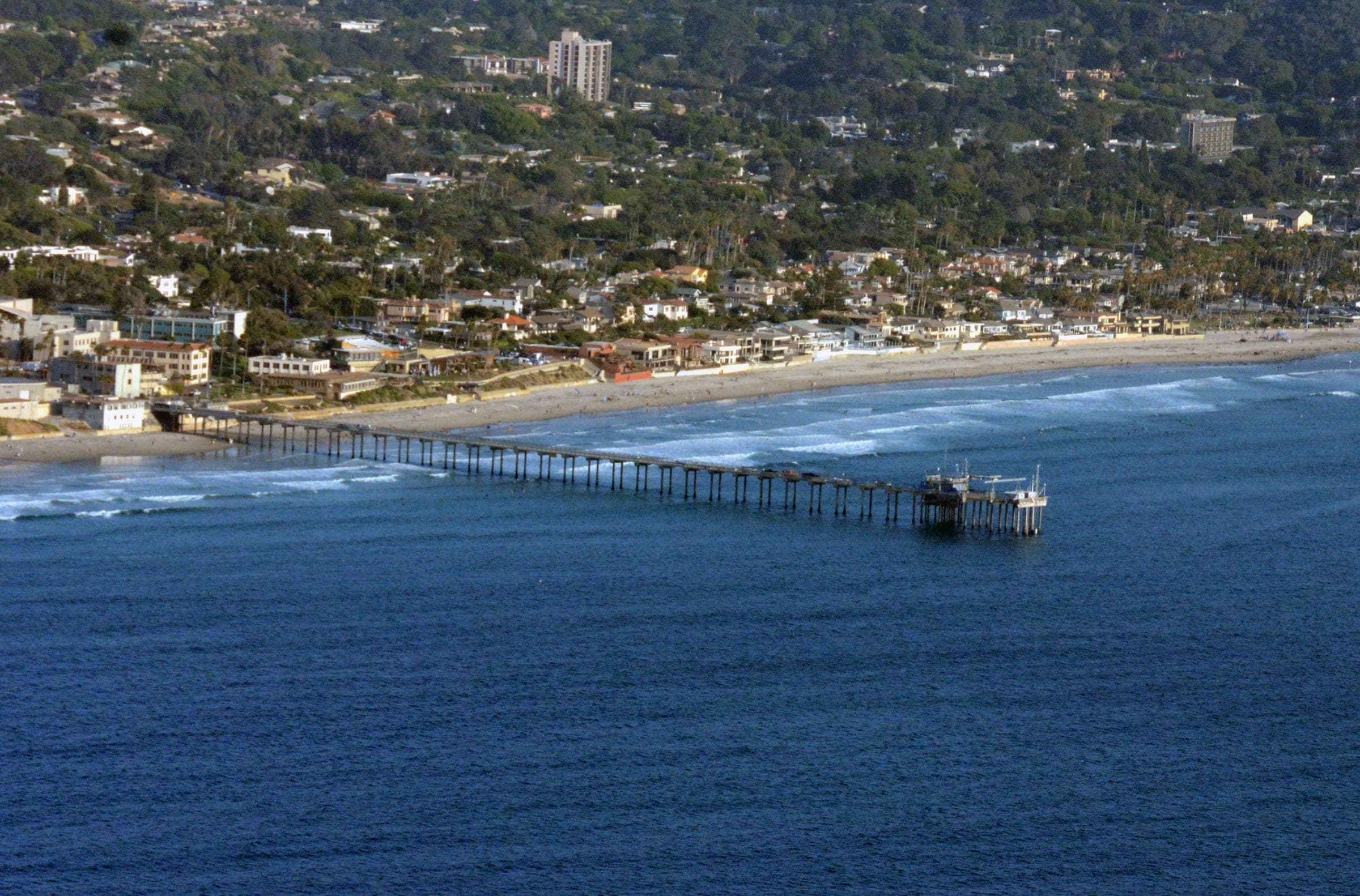
Breaking surf throws salt spray into the air, and the onshore breeze carries it in through an open door. It settles as a fine film, heaviest close to the water.
- 2
Wet tires, sand and grit
Tires, boards and beach gear track in salt water and sand. Grit under tires and shoes is an abrasive that dulls a topcoat in the tire lanes first.
- 3
Sun through the open door
Direct sun ambers an aromatic epoxy topcoat. Winter and late-afternoon sun sits low and reaches deepest into the garage.
- 4
Moisture vapor from below
Ground moisture moves up through concrete. A slab with no vapor retarder under it can push enough vapor to blister a coating from underneath.
- 5
Damp mornings at install time
Under the marine layer the air is humid and a cool slab can sit close to the dew point. Coating it then risks condensation, a weak bond and a cloudy finish.
Salt on its own rarely ruins a well-built floor, because a sealed coating gives it nothing to soak into. What fails is the bond: a coating laid over salt film or efflorescence, over a slab pushing vapor, or onto concrete wet from the morning air. So the order of work matters more near the water than anywhere else in the county.
Live near the water? We test the slab first and put the plan in writing.
Get a Free EstimateSan Diego's coast-to-inland gradient
San Diego has distinct climates within a short drive. The California Energy Commission puts the coast, from Carlsbad and Encinitas through Del Mar, La Jolla, Point Loma and Coronado, and inland as far as Carmel Valley and Rancho Santa Fe, in Building Climate Zone 7. El Cajon, Escondido, Poway, Ramona and Santee fall in Zone 10, a hotter inland zone. A garage floor feels that difference.
Three zones, three different floors
- 1
Beach and bay
The first blocks back from the surf or the bay
Salt film, sand and the most marine-layer mornings. Some neighborhoods sit close to sea level.
Salt in the airMarine-layer dampSummer heat and hot tiresSalt, sand and damp
- 2
Coastal mesas and central neighborhoods
A few miles in, on the mesas, ridges and canyon rims
Gray mornings that usually clear by midday, then strong sun. Older slabs may have no vapor retarder.
Salt in the airMarine-layer dampSummer heat and hot tiresSun and slab moisture
- 3
Inland valleys
Farther east, past the coastal hills
Fewer gray mornings, hotter summer afternoons and hot tires. Heat shortens working time during installs.
Salt in the airMarine-layer dampSummer heat and hot tiresHeat, sun and hot tires
- Poway
- Escondido
- El Cajon
- Ramona
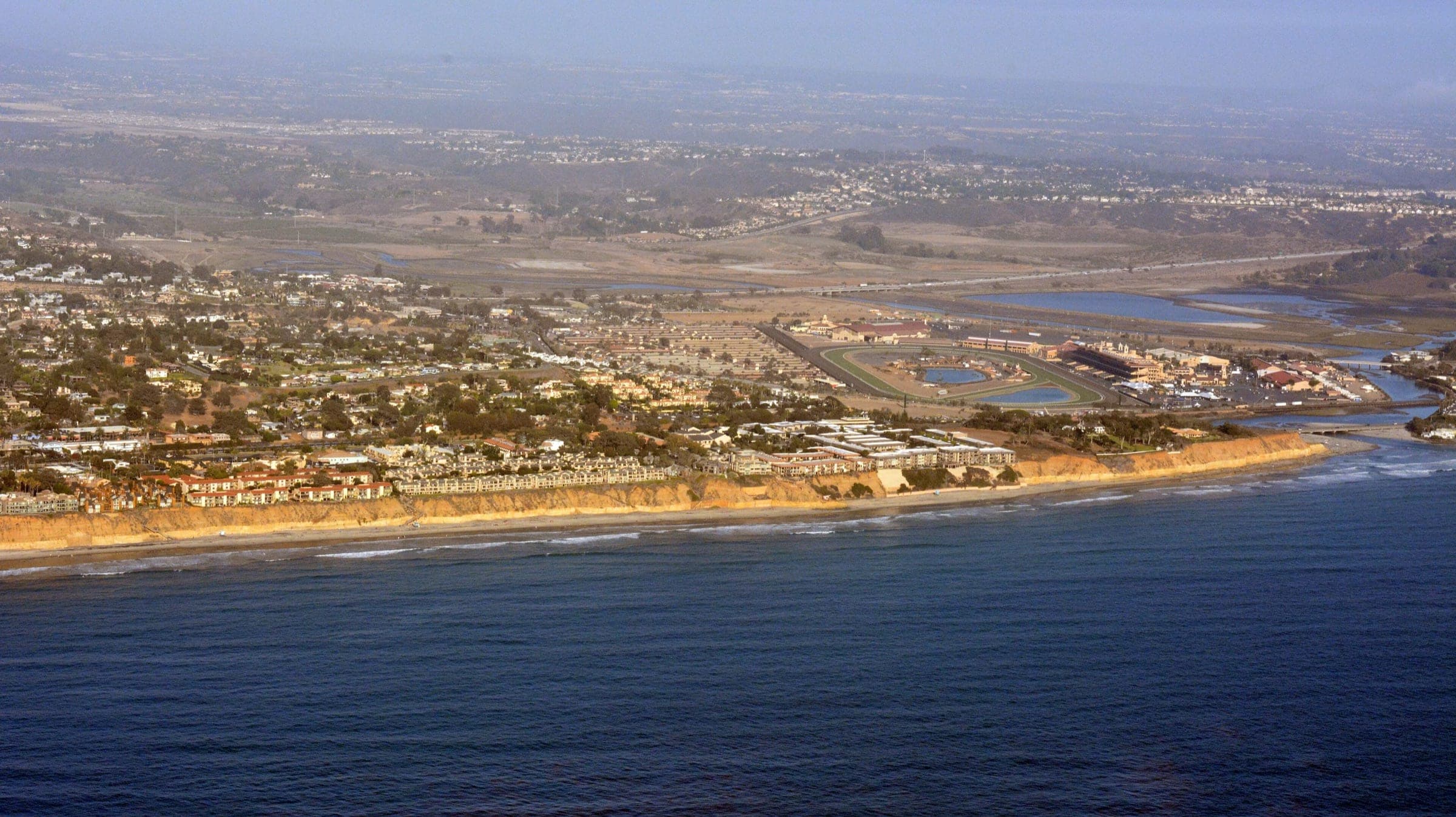
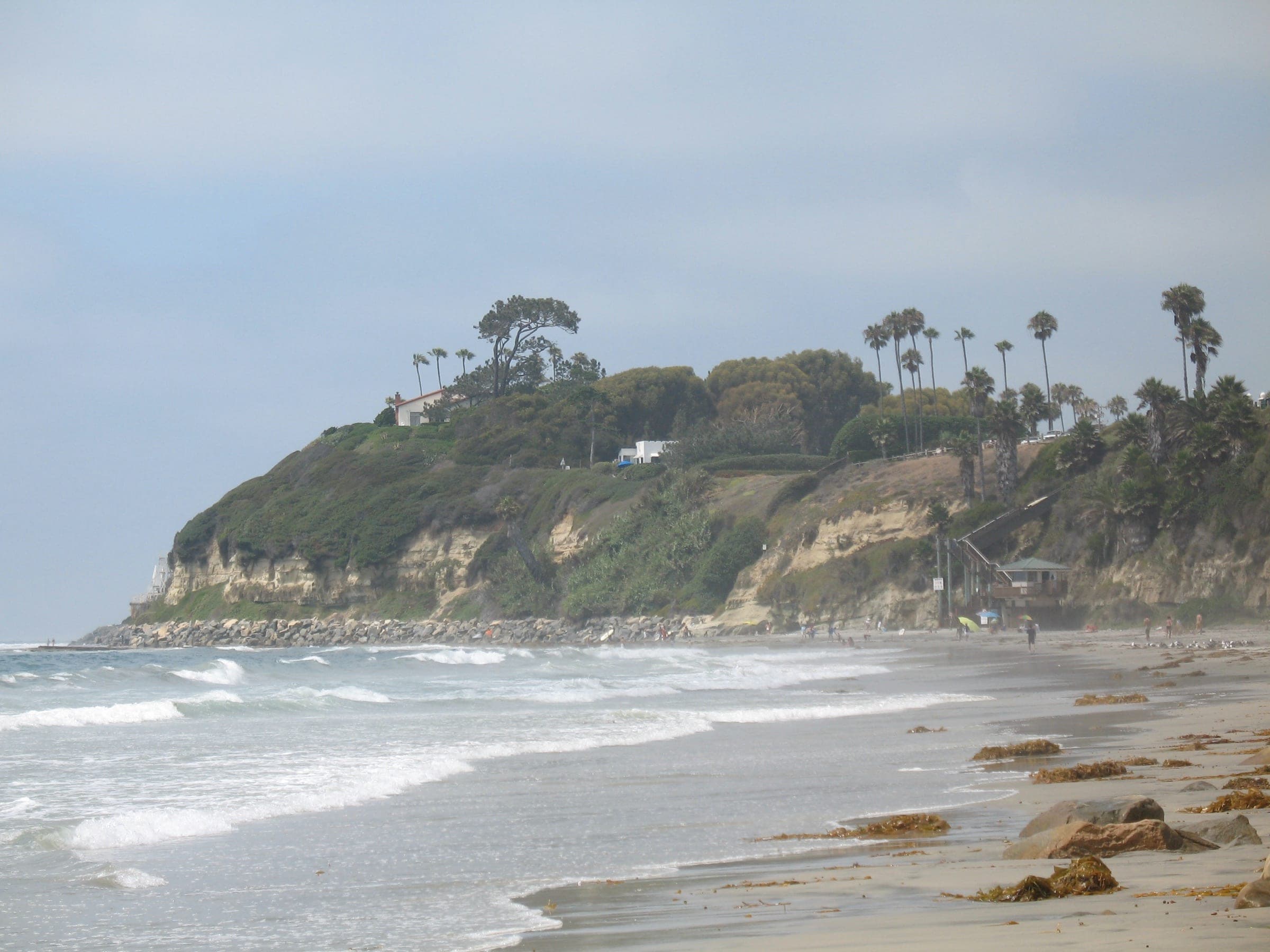
Beach and bay homes in Coronado, Point Loma, La Jolla, Del Mar, Encinitas and Carlsbad get the most salt and the most gray mornings. The National Weather Service notes that low clouds sometimes hang on all day "usually on the coast and less often in the valleys." Some neighborhoods, such as parts of Del Mar and Coronado, sit close to sea level.
Coastal mesas and the central neighborhoods, such as Carmel Valley, Rancho Santa Fe, Hillcrest and North Park, still start many spring mornings under the marine layer, but it usually clears by midday and the afternoons are sunnier and warmer. Older homes here may have slabs with no vapor retarder under them.
Inland valleys see fewer gray mornings and much more heat. The NWS describes daily temperature ranges of only about 15 degrees in the city, but 30 degrees or more a few miles inland. August highs average about 76°F at Lindbergh Field and about 89°F in El Cajon, according to Western Regional Climate Center station records. Hot tires and short working times matter more there than salt does.
Salt air: what it does to a garage floor, and what it doesn't
Breaking waves make the salt. Bubbles bursting in the surf launch tiny droplets of seawater, and research at the Scripps pier in La Jolla ties the amount of surf-made aerosol to how much wave energy is breaking. The onshore breeze carries those droplets inland, and they dry into a fine salt film on cars, door tracks and garage floors.
Most of it lands close to the water. Corrosion researchers have found that the marine effect "extends principally some few hundred meters from the shoreline and decays rapidly further inland", and a field study measured a "drastic reduction of chloride deposition" over the first 200 meters from the sea. Buildings and trees catch salt too, so a garage behind the first row of houses gets much less than a bluff-top house facing the surf. That is why the beach zone in the diagram above is drawn so narrow.
Why salt matters on bare concrete
Chlorides from salt spray and seawater work their way into concrete through its pores. When they reach steel reinforcement they break down its protective film, and the rust that forms takes up more space than the steel, which cracks and spalls the concrete above it. The Federal Highway Administration notes this kind of damage was once seen mainly in coastal areas. Salt that dissolves and recrystallizes inside the pores can also stress the surface from within, as conservation research hosted by the National Park Service describes for stone near the sea.
A sealed, seamless coating stops most of this at the surface. Salt sits on top, where a fresh-water rinse takes it away. The weak spots are bare concrete at the edges and anywhere a coating lifted at the door, so a coastal system should run to the walls and be cut cleanly at the threshold.
Efflorescence: the white powder
White powder or crust on a coastal slab is usually efflorescence: salts dissolved by moisture moving through the concrete and left behind when it evaporates. It means water is moving through the slab. One coatings maker is blunt about it: "efflorescence should not be coated over", because it leaves a friable surface the coating can't grip. It has to be ground off, and the moisture behind it tested and managed, before anything goes down.
Wet tires, sand and grit
Plenty of salt also rides in on tires, boards and wetsuits, but beach sand is the bigger long-term problem. Sherwin-Williams warns that epoxy finishes "will scratch when subjected to abrasive dirt", and a fine layer of sand under tires acts like sandpaper in the tire lanes. A polyaspartic topcoat resists abrasion better than an epoxy one, and a full flake broadcast adds texture for grip with wet feet. See how a flake epoxy floor is built.
Moisture from below: older slabs and missing vapor barriers
Concrete is porous, and ground moisture moves up through it as vapor. A coating seals the top, so vapor rising underneath can push up blisters or break the bond. It is a common cause of coating failure near the coast, and it has little to do with salt.
Today's California Residential Code requires a 10-mil vapor retarder under most slabs on grade, but its exception list starts with "Garages, utility buildings and other unheated accessory structures." So even a new garage slab may have no vapor retarder, and for many years vapor retarders were specified only under slabs meant to receive floor coverings. The concrete industry's own guidance puts slabs that will get vapor-sensitive coatings directly on a vapor retarder for exactly this reason.

How a slab is tested
- Calcium chloride test (ASTM F1869): a dish of salt sealed under a dome on bare concrete measures how much vapor comes out, in pounds per 1,000 square feet per 24 hours. The standard is for bare concrete only, so old coatings come off first.
- In-slab relative humidity (ASTM F2170): a probe sits in a hole drilled to 40% of the slab's depth and reads the humidity inside after it settles, typically 24 hours.
- What the numbers mean: limits come from each product's data sheet. Many garage coatings cap emission at about 3 pounds or in-slab humidity around 75%, and some epoxies allow up to 85%. A slab that tests above the limit gets a moisture-mitigating epoxy primer before the color coats.
The marine layer and install timing
The marine layer is the cool, moist air trapped under a temperature inversion above the ocean. When it cools enough, it forms the low clouds and fog that Southern Californians call May Gray and June Gloom. The NWS in San Diego describes low clouds that form regularly at night, often reach the coastal valleys and foothills, and usually clear during the morning. Scripps and USGS researchers found that June is the cloudiest month along the Southern California coast.
Gray season in the numbers: Lindbergh Field
- Relative humidity, early morning (4 am)
- Relative humidity, late afternoon (4 pm)
Two numbers matter during an install. Before dawn the air at the coast is close to saturated, and the NWS notes near 100% humidity is typical late at night and early in the morning in spring and summer. And several polyaspartic data sheets say not to apply above about 80 to 85% humidity, because moisture speeds the cure. By mid-afternoon, Lindbergh Field averages 56 to 66%, which is why coastal crews work after the gray lifts rather than at first light.
Dew point: the 5°F rule
Coating data sheets require the slab to be at least 5°F above the dew point. As one epoxy data sheet puts it, closer than that risks condensation, "which may lead to adhesion failure or blushing." A garage slab cools overnight and warms slowly, so on a gray May morning it can sit right at the dew point even when the air feels fine. Try it with real readings.
Is it safe to coat? Dew point check
Too close. The slab is only 1.6°F above the dew point; wait for it to warm or for the air to dry. Humidity is above 80%, too: several polyaspartic data sheets say to wait for drier air.
For May and June installs near the coast, that usually means grinding and repairs in the morning and coating from late morning on, with a reading before each coat. In late summer the marine layer is shallower, around 1,000 to 1,500 feet by August compared with 2,000 to 2,500 feet in June per the NWS, and beaches clear almost every afternoon from mid-July through September. Inland, the challenge flips: heat shortens working time, so crews start early. The epoxy vs polyaspartic guide shows how heat and humidity shorten polyaspartic working time.
UV through the open door
Standard floor epoxy is aromatic, and aromatic coatings yellow in sunlight. The American Chemistry Council describes how aliphatic coatings were developed to fix exactly that, "maintaining color stability and preventing yellowing." Polyaspartic is one of those aliphatic chemistries. San Diego's sun is strong all year: the EPA's monthly UV maps put the coast's July average around 10 to 11.
How much of that sun lands on your floor depends on which way the door faces and the season. The calculator below uses NOAA's solar position equations for San Diego. With the door open at 3 pm on December 21, direct sun reaches about 16 feet into a west-facing garage, past the tire lanes. A south-facing garage gets sun about 10 feet deep at noon in December but only about a foot at noon in June, when the sun is nearly overhead. North-facing garages get none in winter and only low morning and evening sun in summer.
How far does the sun reach into your garage?
Garage door faces
- At 3:00 pm
- 16 ft
- Sun on the floor
- 4.1 h a day
- Deepest reach
- 22+ ft at 4:10 pm
With the door open all day, a west-facing garage gets direct sun at least a foot onto the floor for about 4.1 hours on Dec 21. The low sun reaches deep enough to cross the tire lanes and the main parking area.
If the floor gets any regular sun, the clear topcoat should be polyaspartic. One caveat: a UV-stable topcoat over a clear or solid epoxy base does not fully protect the epoxy beneath it, and one manufacturer's data sheet warns that a clear UV-resistant topcoat "may not prevent discoloration of underlying coatings." A full flake broadcast hides the base, which is one more reason flake systems suit open coastal garages. More on the chemistry is in polyaspartic floor coatings.
Which system fits which zone
The base and topcoat choices are the same anywhere in the county. What changes by zone is the prep, how much the moisture test is likely to matter, when the crew coats and how the floor is cared for.
Coastal vs inland: a garage floor spec by zone
| Step | 1Beach and bay | 2Coastal mesas and central neighborhoods | 3Inland valleys |
|---|---|---|---|
| Prep | Diamond grind; scrub off salt film and grind away any white efflorescence | Diamond grind; remove old paint and repair cracks | Diamond grind; repair cracks and spalls |
| Moisture test | Always; plan for a mitigating primer if it reads high | Always; older slabs may have no vapor retarder | Always; dry air does not mean a dry slab |
| Base coat | Moisture-mitigating epoxy primer if readings are high, otherwise 100% solids epoxy | 100% solids epoxy, or a mitigating primer if readings are high | 100% solids epoxy or polyurea base, built thick for hot tires |
| Color layer | Full flake broadcast; textured enough to grip with wet feet | Full flake broadcast | Full flake broadcast; lighter blends stay cooler underfoot |
| Topcoat | Aliphatic polyaspartic, UV-stable and abrasion resistant | Aliphatic polyaspartic | Aliphatic polyaspartic |
| Install timing | Start after the gray lifts; check slab vs dew point before every coat | Late morning to afternoon in May and June; dew point check each coat | Start early on hot days; small batches or a slower formula |
| Care | Sweep sand often; rinse salt off with fresh water | Sweep grit; mats at the door to the house | Sweep grit; avoid parking straight off the freeway in the first weeks |
1Beach and bay
- Prep
- Diamond grind; scrub off salt film and grind away any white efflorescence
- Moisture test
- Always; plan for a mitigating primer if it reads high
- Base coat
- Moisture-mitigating epoxy primer if readings are high, otherwise 100% solids epoxy
- Color layer
- Full flake broadcast; textured enough to grip with wet feet
- Topcoat
- Aliphatic polyaspartic, UV-stable and abrasion resistant
- Install timing
- Start after the gray lifts; check slab vs dew point before every coat
- Care
- Sweep sand often; rinse salt off with fresh water
2Coastal mesas and central neighborhoods
- Prep
- Diamond grind; remove old paint and repair cracks
- Moisture test
- Always; older slabs may have no vapor retarder
- Base coat
- 100% solids epoxy, or a mitigating primer if readings are high
- Color layer
- Full flake broadcast
- Topcoat
- Aliphatic polyaspartic
- Install timing
- Late morning to afternoon in May and June; dew point check each coat
- Care
- Sweep grit; mats at the door to the house
3Inland valleys
- Prep
- Diamond grind; repair cracks and spalls
- Moisture test
- Always; dry air does not mean a dry slab
- Base coat
- 100% solids epoxy or polyurea base, built thick for hot tires
- Color layer
- Full flake broadcast; lighter blends stay cooler underfoot
- Topcoat
- Aliphatic polyaspartic
- Install timing
- Start early on hot days; small batches or a slower formula
- Care
- Sweep grit; avoid parking straight off the freeway in the first weeks
For many coastal garages the best fit is a hybrid: a 100% solids garage floor epoxy base (or a mitigating primer), a full flake broadcast and a polyaspartic topcoat. A newer, dry slab can take a one-day full polyaspartic system. Spalled or salt-damaged concrete may need concrete resurfacing before any coating. Typical 2027 ranges for each system are in our 2027 San Diego price guide. Answer a few questions for a starting plan.
Coastal garage checklist
01Where is the house?
02How much sun reaches the floor?
03How old is the slab?
Answer the first three to see a starting plan for your floor. Nothing is sent anywhere until you ask for an estimate.
A coastal maintenance routine
A coated floor near the beach needs little care, but it does need it regularly, because sand and salt build up faster than they do inland. Manufacturers agree on the basics: sweep or dust-mop grit before it scratches the finish, clean with a pH-neutral cleaner, and avoid acidic or harsh chemicals.
Care routine for a coastal garage floor
Every week
- Dust-mop or sweep sand and grit
- Wipe oil, fluids and pool chemicals as soon as you see them
After beach days and rain
- Rinse salt water and sand off the tire lanes with fresh water
- Squeegee standing water toward the door
Every month
- Mop with a pH-neutral cleaner, then rinse
- Shake out walk-off mats at the door and the house entry
Every year
- Look for dull tire lanes, chips and lifted edges
- Check the door seal and keep the slab edge free of standing water
When the tire lanes dull
- Scuff-sand and recoat the clear topcoat before wear reaches the color layer
Hot tires are the other thing to watch, inland more than at the beach. Tire rubber contains plasticizers that can stain or lift a coating, and it happens most when tires are hot. A thick, fully cured system resists it, and it helps to avoid parking straight off the freeway in the first weeks.
Sources and further reading
- NOAA JetStream: the marine layer
- NWS Technical Memorandum WR-270: Climate of San Diego, California
- NWS Technical Memorandum WR-277 (NWS San Diego, 2006): marine layer depth and low clouds
- Clemesha et al. (2016), coastal low cloudiness in California, Geophysical Research Letters
- Western Regional Climate Center: average morning relative humidity by city
- Western Regional Climate Center: average afternoon relative humidity by city
- Western Regional Climate Center: El Cajon station summary
- Western Regional Climate Center: San Diego Lindbergh Field station summary
- California Energy Commission: building climate zones
- EPA: monthly average UV index, 2006 to 2023
- NOAA Global Monitoring Laboratory: solar calculation details
- van Eijk et al. (2011), surf-generated aerosol measured at the Scripps pier, Journal of Geophysical Research
- Feliu, Morcillo and Chico (1999), effect of distance from sea on atmospheric corrosion rate, Corrosion
- Meira et al. (2003), chloride deposition from marine aerosol vs distance from the sea, Materiales de Construccion
- FHWA-RD-98-088: chloride-induced corrosion of reinforced concrete
- Scherer, Flatt and Wheeler (2001), materials science research for the conservation of sculpture and monuments, MRS Bulletin (NPS NCPTT)
- Dulux Protective Coatings Technical Note 1.3.4: efflorescence
- 2022 California Residential Code R506.2.3: vapor retarder
- NRMCA Concrete in Practice 29: vapor retarders under slabs on grade
- ASTM F1869: moisture vapor emission rate using anhydrous calcium chloride
- ASTM F2170: relative humidity in concrete floor slabs using in situ probes
- Wagner Meters: correct and accurate RH testing in concrete
- Example data sheet: Sikafloor-264 epoxy
- American Chemistry Council: aliphatic diisocyanates in architectural coatings
- Sherwin-Williams: general resin flooring maintenance and cleaning
- Armorpoxy: tire staining on coated floors
Written by Bedrock Epoxy Garage Floors & Concrete Coatings. Prices are typical 2027 San Diego ranges from our cost guide, not quotes. Images are illustrations, not photos of our projects.