On this page
The short answer
If you park in the garage and open the door most days, a flake system with a polyaspartic topcoat is the best garage floor coating for the money. The concrete is diamond ground and tested for moisture, a base coat bonds to it, vinyl flake is broadcast into the wet base until it is fully covered, and a clear aliphatic polyaspartic coat goes on top. That topcoat holds its color in sun and wears well under tires, and the flake hides dust and scuffs between cleanings.
"Best" still depends on the garage. Here is how the usual situations sort out.
Your situation and what usually fits
| Your situation | Usually the best fit | Why |
|---|---|---|
| Daily-driver garage, door often open | Flake system with a polyaspartic topcoat | UV-stable top; hides dust and wear; resists hot tires when well bonded |
| Need the garage back fast, dry slab | Full polyaspartic or polyurea | Often a one-day install, with parking in 24 to 48 hours |
| Older slab, damp spots or white powder | Moisture-mitigating epoxy primer, flake, polyaspartic top | Epoxy primers handle a damper slab than polyaspartic can |
| Closed garage, gym or shop on a budget | Epoxy system, solid color or flake | No sun, so yellowing barely matters, and it costs less |
| Show garage out of the sun | Metallic epoxy with a protective topcoat | The most decorative finish; keep it out of direct sun |
| Renting, or the slab can't be ground | Interlocking tiles or a roll-out mat | No prep and removable, but liquids and grit get underneath |
| Tightest budget, a floor you don't mind redoing | DIY kit or floor paint | Cheapest, with a thin film and touch-ups in the tire lanes |
Want the options priced for your garage? We test the slab first and quote each system side by side.
Get a Free EstimateGarage floor coating options compared
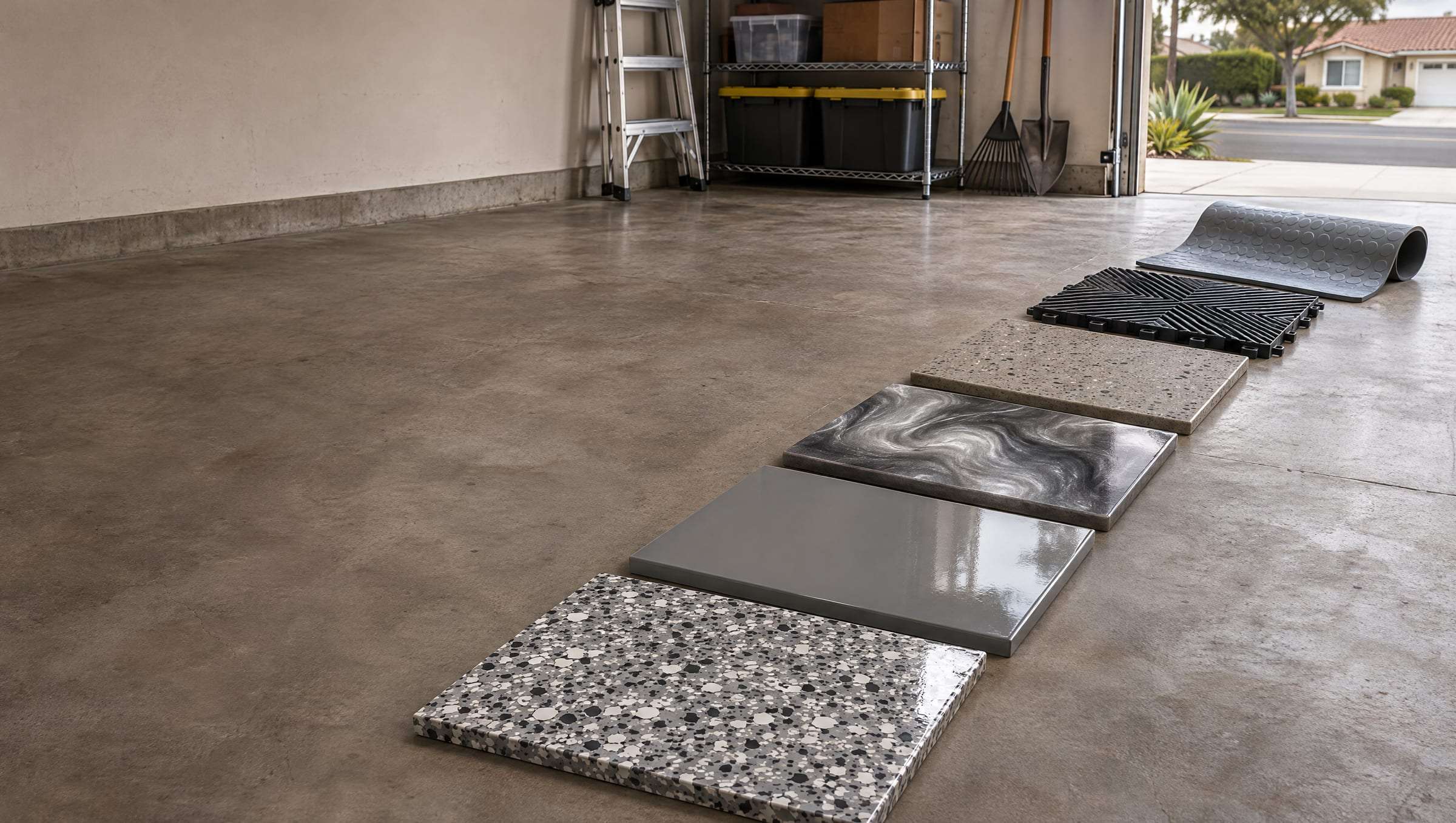
Nine options come up when people shop for a garage floor. They differ in how long they last, how they handle hot tires and sun, how soon you can park, and what they cost. Rank them by what matters to you, or narrow the list to professional systems or DIY and retail products.
Every garage floor option, ranked your way
Showing 9 options.
Flake system, polyaspartic topcoatPro installedUsual best fit
Full flake in any blend, gloss or satin
- Durability
- 5 of 5
- Hot tires
- 4 of 5
- Sun
- 5 of 5UV-stable top
- Back in use:
- Usually 2 days to install; park 24 to 48 hours after the topcoat
- Typical cost:
- Upper half of $5 to $8 per sq ft installed
- Best for:
- Most daily-driver garages, sun or not, and older slabs that need a moisture primer
- Watch out:
- Only as good as the grinding and moisture test under it
Full polyaspartic or polyureaPro installed
Full flake or solid color, gloss or satin
- Durability
- 5 of 5
- Hot tires
- 4 of 5
- Sun
- 5 of 5UV-stable
- Back in use:
- Often 1 day to install; park in 24 to 48 hours
- Typical cost:
- $6 to $10 per sq ft installed
- Best for:
- Sunny, open garages on a dry slab when you need the garage back fast
- Watch out:
- Needs a dry slab and an experienced crew; short working time
Professional epoxy systemPro installed
Solid color or flake, high gloss
- Durability
- 4 of 5
- Hot tires
- 4 of 5
- Sun
- 1 of 5Ambers in direct sun
- Back in use:
- 2 to 3 days to install; park 2 to 3 days after the last coat
- Typical cost:
- Lower half of $5 to $8 per sq ft installed
- Best for:
- Closed garages, gyms and shops where the sun never reaches the floor
- Watch out:
- An epoxy topcoat yellows and dulls where sun hits it
Metallic epoxyPro installed
Marbled, deep gloss, no two alike
- Durability
- 3 of 5
- Hot tires
- 4 of 5
- Sun
- 1 of 5Ambers in direct sun
- Back in use:
- Several days; the topcoat sets the drive-on time
- Typical cost:
- $8 to $15 per sq ft installed
- Best for:
- Show garages, studios and interiors out of direct sun
- Watch out:
- Not for sun: data sheets keep it out of high UV. Deep gloss also shows scratches and dust
Polished or sealed concretePro installed
The concrete itself with a sheen; cracks and patches stay visible
- Durability
- 4 of 5
- Hot tires
- 5 of 5
- Sun
- 5 of 5No coating to yellow
- Back in use:
- Usable once the final guard coat dries
- Typical cost:
- $4 to $12 per sq ft installed
- Best for:
- Sound slabs in clean shops and show spaces
- Watch out:
- Oil, brake fluid and acids can stain or etch it if not wiped up
Interlocking tilesDIY or retail
Colors, patterns and borders; seams show
- Durability
- 4 of 5
- Hot tires
- 5 of 5
- Sun
- 3 of 5Varies by product
- Back in use:
- Same day, nothing to cure
- Typical cost:
- About $1.75 to $6 per sq ft (retail, check current)
- Best for:
- Renters, cracked or stained slabs you can't grind, quick makeovers
- Watch out:
- Not watertight: liquids and grit can get underneath, and tiles lift out to clean below
Roll-out matsDIY or retail
Ribbed, coin or diamond texture in a few colors
- Durability
- 3 of 5
- Hot tires
- 4 of 5
- Sun
- 3 of 5Varies by product
- Back in use:
- Same day, nothing to cure
- Typical cost:
- About $2 to $3.50 per sq ft (retail, check current)
- Best for:
- Covering one parking spot fast, or a rental
- Watch out:
- Tire marks are possible, and the maker says to lift it now and then to air the slab
DIY epoxy kitDIY or retail
Solid color with a sprinkle of chips
- Durability
- 2 of 5
- Hot tires
- 2 of 5
- Sun
- 1 of 5Ambers in direct sun
- Back in use:
- About 3 days before parking, per one kit's data sheet
- Typical cost:
- $100 to $300 for a basic 2-car kit; pro-grade kits about $1 to $2.50 per sq ft in material
- Best for:
- A dry slab you don't mind redoing, on a tight budget
- Watch out:
- One thin coat over an etched slab leaves little margin for hot tires
Concrete paint or sealerDIY or retail
Flat or satin color, or bare concrete under a sealer
- Durability
- 1 of 5
- Hot tires
- 1 of 5
- Sun
- 3 of 5Varies by product
- Back in use:
- Paint: 5 to 7 days before tires, per data sheets
- Typical cost:
- Paint: about 10 to 30 cents per sq ft per coat (retail, check current)
- Best for:
- Dust-proofing and a quick refresh
- Watch out:
- Makers expect touch-ups in the tire lanes; acrylic sealers need recoating often
DIY kits, paint and sealers
Big-box kits and floor paints are thin. One popular two-part kit's data sheet calls for a single coat at 3.0 to 3.5 mils dry over a citric acid etch, with 3 days before vehicles. A one-part epoxy floor paint goes on at 1.0 to 2.5 mils per coat, needs 5 days before vehicles and notes that occasional touch-ups may be needed where cars drive. A professional garage system is about 20 to 40 mils across its layers. The makers rate these products to resist hot tires, but a film that thin, bonded to an etched slab, has little margin.
Clear acrylic sealers form an even thinner film, and one sealer maker's own data sheet says its product "does not stop hot tire pickup or tire marks." Penetrating silane and siloxane sealers soak in instead of forming a film, so there is nothing to peel, but the slab still looks like bare concrete.
Professional epoxy
Professional floor epoxy is usually 100% solids, so what goes on the floor stays there and one coat builds real thickness. It bonds well to ground concrete, which makes it the standard base coat under most garage systems. Its weakness is sunlight. Epoxy is aromatic, and data sheets say so plainly: one flake system's epoxy base "is not light stable and will yellow/amber over time." In a closed garage that barely matters. In an open, west-facing garage, an epoxy topcoat ambers and dulls in the strip of floor the sun reaches. See garage floor epoxy.
Polyaspartic and polyurea
Polyaspartic is an aliphatic polyurea made from aspartic resins and aliphatic isocyanates. Covestro, which makes the resins, describes it as a lightfast coating that cures much faster than conventional floor systems. In a garage that means a clear topcoat that holds its color in sun, and a system that can often be ground, coated and topcoated in one day. The trade-offs are a slab that must test dry, a short working time and a higher price. Polyurea is the wider family: when a company sells a polyurea floor, the base may be a fast polyurea and the clear top is usually a polyaspartic. Our epoxy vs polyaspartic guide goes deeper, and polyaspartic floor coatings shows how we build them.
Flake or solid color
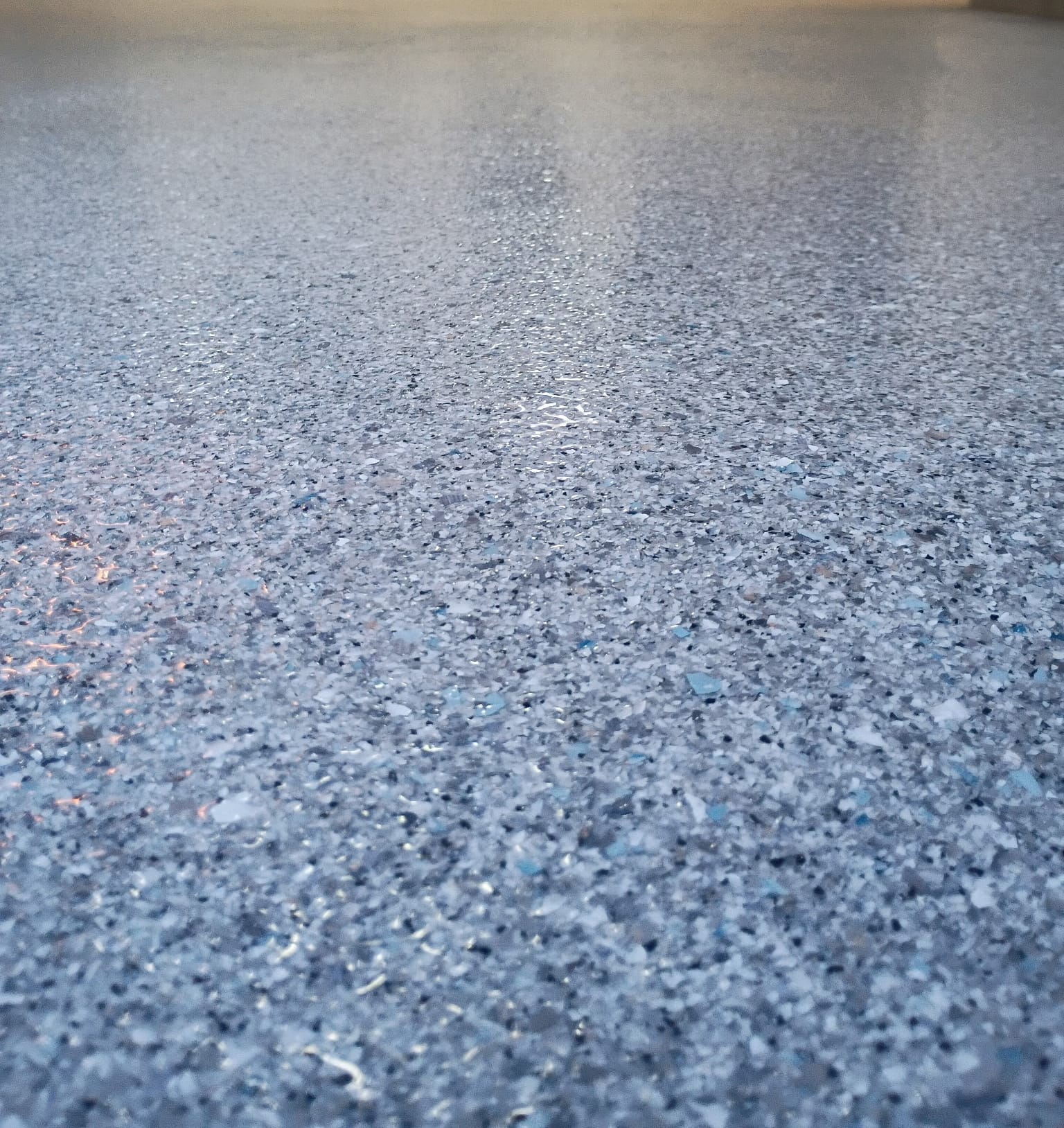
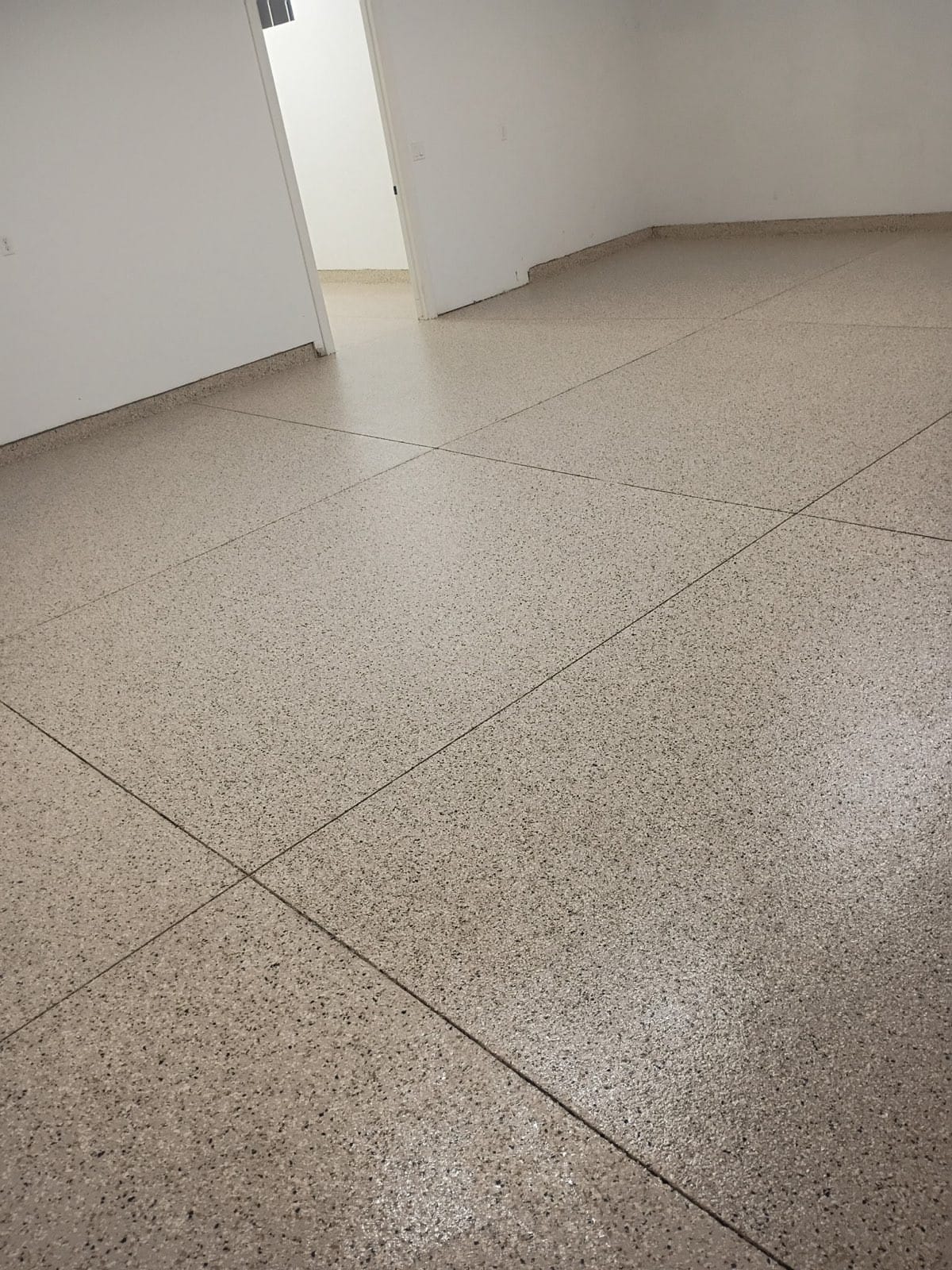
Flake is a finish, not a chemistry. Chips broadcast to full coverage give the floor texture underfoot and a speckled pattern that hides dust, sand and small scuffs. A solid color looks crisp and makes dropped screws easy to find, but it shows every tire mark and bit of grit. For a garage you park in, full flake is the forgiving choice; see how flake epoxy floors are built, or browse blends in our flake color chart.
Metallic epoxy
Metallic epoxy uses metallic pigments worked by hand into a marbled, deep-gloss finish. It is the most decorative option and the priciest per square foot, typically $8 to $15 in San Diego. It is still epoxy, though: one metallic epoxy data sheet says not to apply it "outdoors or where the epoxy is subject to high UV exposure," and the gloss shows dust and fine scratches. It suits a closed show garage, a studio or an interior room. See metallic epoxy floors.
Polished or sealed concrete
Polishing grinds the slab itself to a sheen and hardens it with a penetrating densifier, so there is no coating to peel. It needs a sound slab, because it shows cracks, patches and old stains instead of hiding them; one stain guard's data sheet notes that it "will not compensate for structural defects." It is not stain-proof either. The same sheet warns that acids "may etch and stain," and oil and brake fluid need wiping up while fresh. That makes it a better fit for a clean shop or show space than for a garage with a car that drips. It typically runs $4 to $12 per square foot in San Diego; see concrete polishing.
Tiles and mats
Interlocking polypropylene tiles and roll-out vinyl mats skip the prep. Tiles snap together and sit on top of the slab with no adhesive, covering cracks and stains, and perforated styles let water run through. A mat rolls out in one piece. Both go down in an afternoon and leave with you when you move, which makes them the honest answer for renters.
The catches: tile seams are not watertight, so spills and grit can end up underneath, and tiles come up to clean below them. One mat maker's FAQ answers "Tire marks?" with "Possible" and says to lift the mat now and then to ventilate. Retail prices we found in November 2026 ran about $1.75 to $6 per square foot for tiles and $2 to $3.50 for mats, before edge trim or ramps, so premium tiles cost close to a professional coating.
Why prep matters more than the product
The coating on the label gets the attention, but the slab under it decides whether the floor lasts. Sherwin-Williams, one of the largest coatings makers, puts it bluntly: "the number one reason for coating failure is lack of, or improper, surface preparation." Two things decide it: how the concrete is opened up, and how much moisture is coming through it. Switch the prep and the moisture below to see why.
Same coating, three kinds of prep
Surface prep
Slab moisture
- 1Clear topcoat
- 2Flake broadcast
- 3Base coat
- 4Surface profile
- 5Concrete slab
Built to bond
- Profile
- About CSP 3 or a little rougher, which is what garage base-coat data sheets ask for.
- What's left on the surface
- The weak top skin, old sealer and surface contaminants are ground away, leaving open, sound concrete.
- Bond
- The base coat soaks into the pores and locks into the texture.
- Moisture
- The reading is within the product's limit (for example 3 lb on ASTM F1869 or 75% RH on ASTM F2170), or a moisture-mitigating primer goes down first.
Diamond grinding vs acid etching
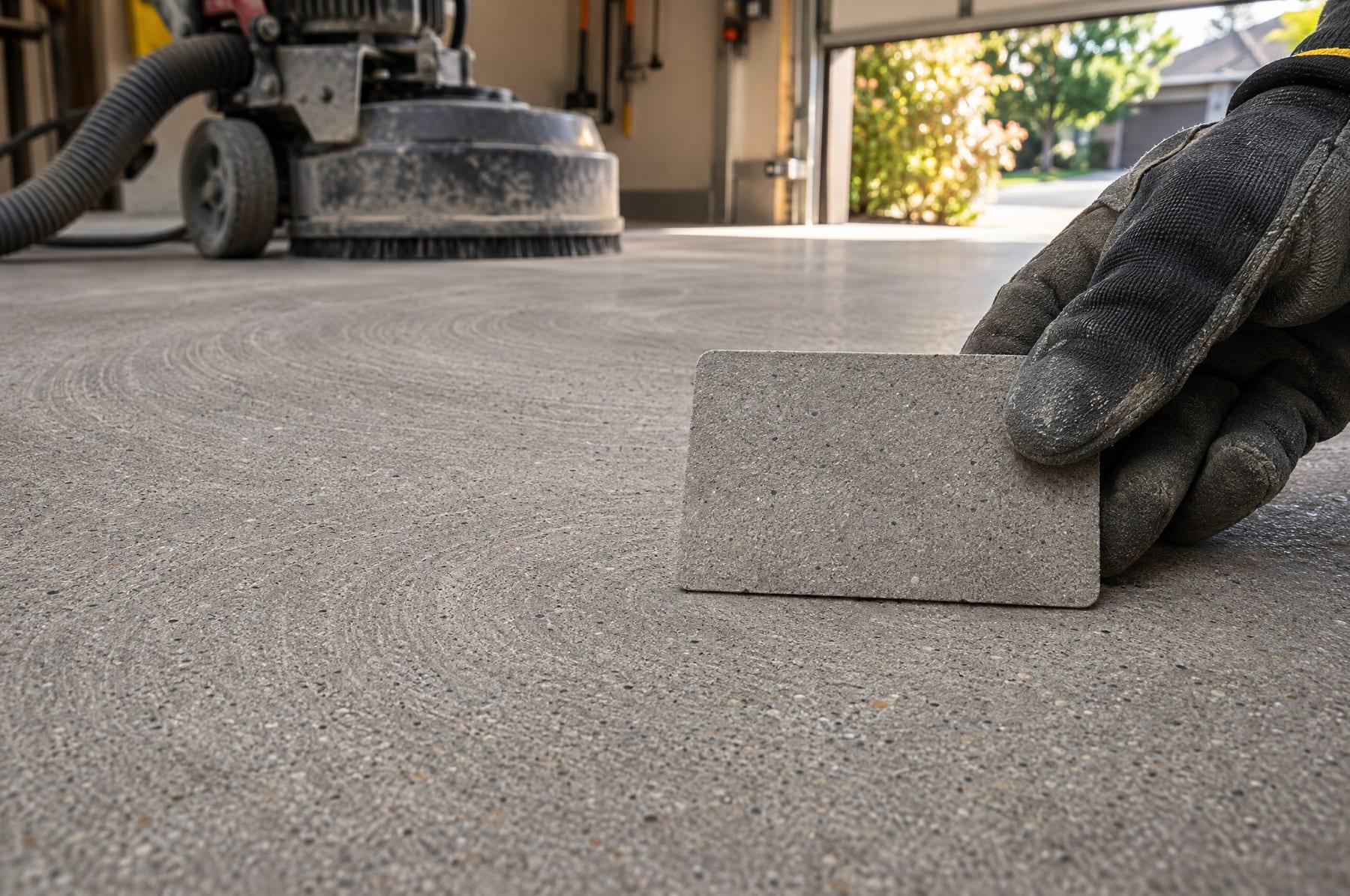
The International Concrete Repair Institute grades concrete texture from CSP 1, nearly flat, to CSP 10, very rough, and sells replica chips so a crew can match a floor to the standard. The thicker the coating, the rougher the profile it needs. Garage base coats typically call for about CSP 3 or more: one epoxy data sheet says to "diamond grind or shotblast to a CSP 3 or greater surface profile."
Acid etching, the prep many DIY kits call for, can't get there. Sherwin-Williams says acid etching "tends to produce a CSP-1 to CSP-2 profile," suitable only for very thin systems, and that it "cannot remove curing compounds or many of the contaminants" that interfere with adhesion. A diamond grinder with dust collection takes off the weak top layer of the slab along with old sealer and stains, and leaves an even texture the base coat can lock into.
Test the moisture first
Concrete passes moisture vapor up from the ground, and a coating seals the top. If the vapor can't escape, it can blister the coating from below. Two standard tests measure it: the calcium chloride test, ASTM F1869, which reports pounds of vapor per 1,000 square feet per day, and an in-slab relative humidity probe, ASTM F2170. The limits come from each product's data sheet; the epoxy data sheet above caps them at 3 pounds and 75%. A slab that reads higher gets a moisture-mitigating epoxy primer before anything else. California's residential code also exempts garages from the vapor retarder rule, so a garage slab may have none, as our coastal garage floors guide explains.
What San Diego adds to the decision
San Diego is easy on concrete in some ways: no freeze-thaw cycles and no road salt. Four local conditions still shape which coating is best.
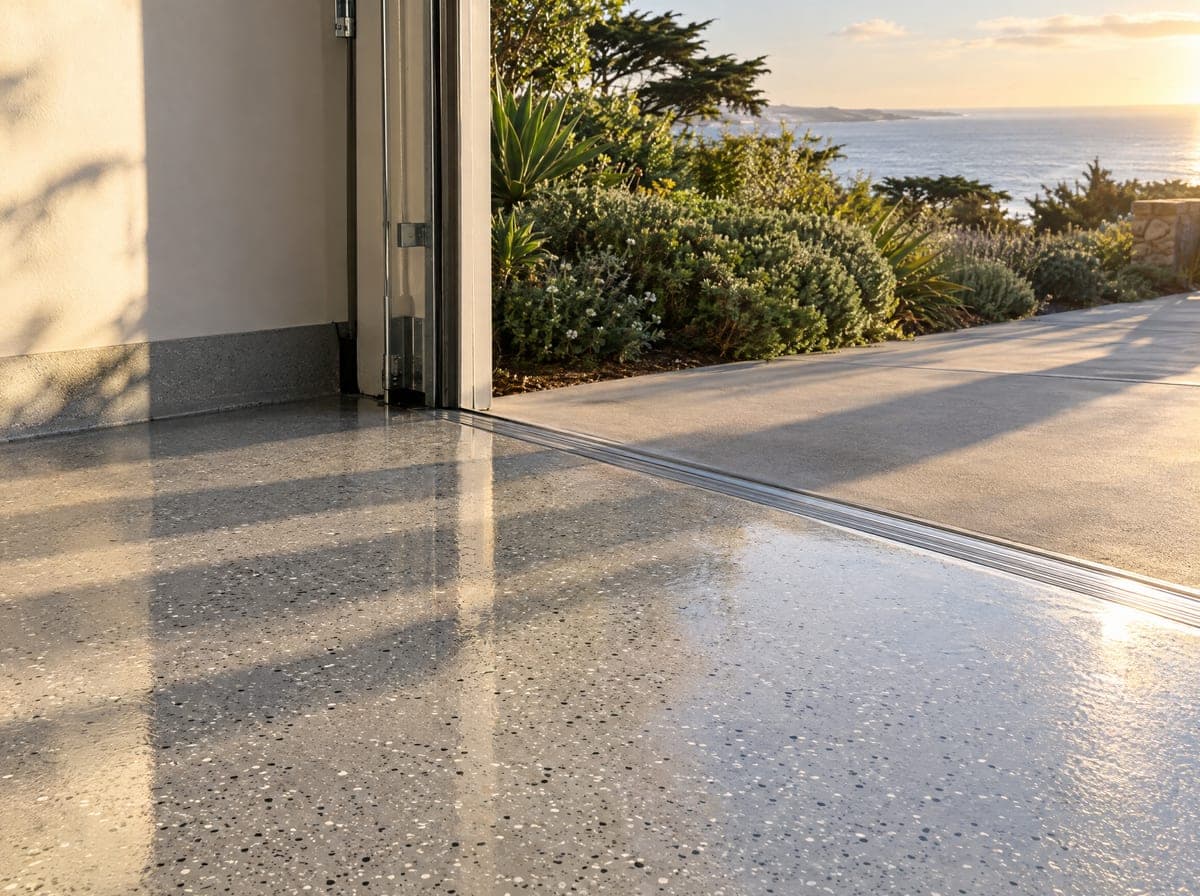
- Sun through an open door. UV is strong here all year, and garage doors stand open for hours. Low afternoon sun reaches deep into west-facing garages, which is where an epoxy topcoat ambers first. That makes a UV-stable polyaspartic topcoat the default for most homes.
- Salt air and beach sand. Near the water, salt settles on everything and sand rides in on tires. A sealed coating keeps salt out of the concrete, and a polyaspartic topcoat resists grit in the tire lanes better than epoxy does.
- Marine-layer mornings. May Gray and June Gloom bring humid air and cool slabs. Data sheets want the slab at least 5°F above the dew point for every coat, so coastal crews often coat after the gray lifts.
- Inland heat and hot tires. Inland summers run much hotter than the coast. Hot tires can lift a poorly bonded coating, and tire rubber can stain almost any finish through plasticizer migration. A well-bonded, fully cured system handles the first. For the second, data sheets suggest a piece of plexiglass under the tires of a car that stays parked.
The coastal garage floors guide covers salt, the marine layer and sun angles in more depth, with a calculator for how far the sun reaches into your garage.
The best coating for how you use the garage
The same slab can call for a different floor depending on what happens on it.
- Daily-driver garage. A full flake broadcast over an epoxy base with a polyaspartic topcoat, or full polyaspartic if you need the garage back in a day. Flake hides dust, drips and tire scuffs, and the topcoat handles sun through the door. Typical San Diego ranges are $5 to $8 per square foot for a flake system and $6 to $10 for full polyaspartic.
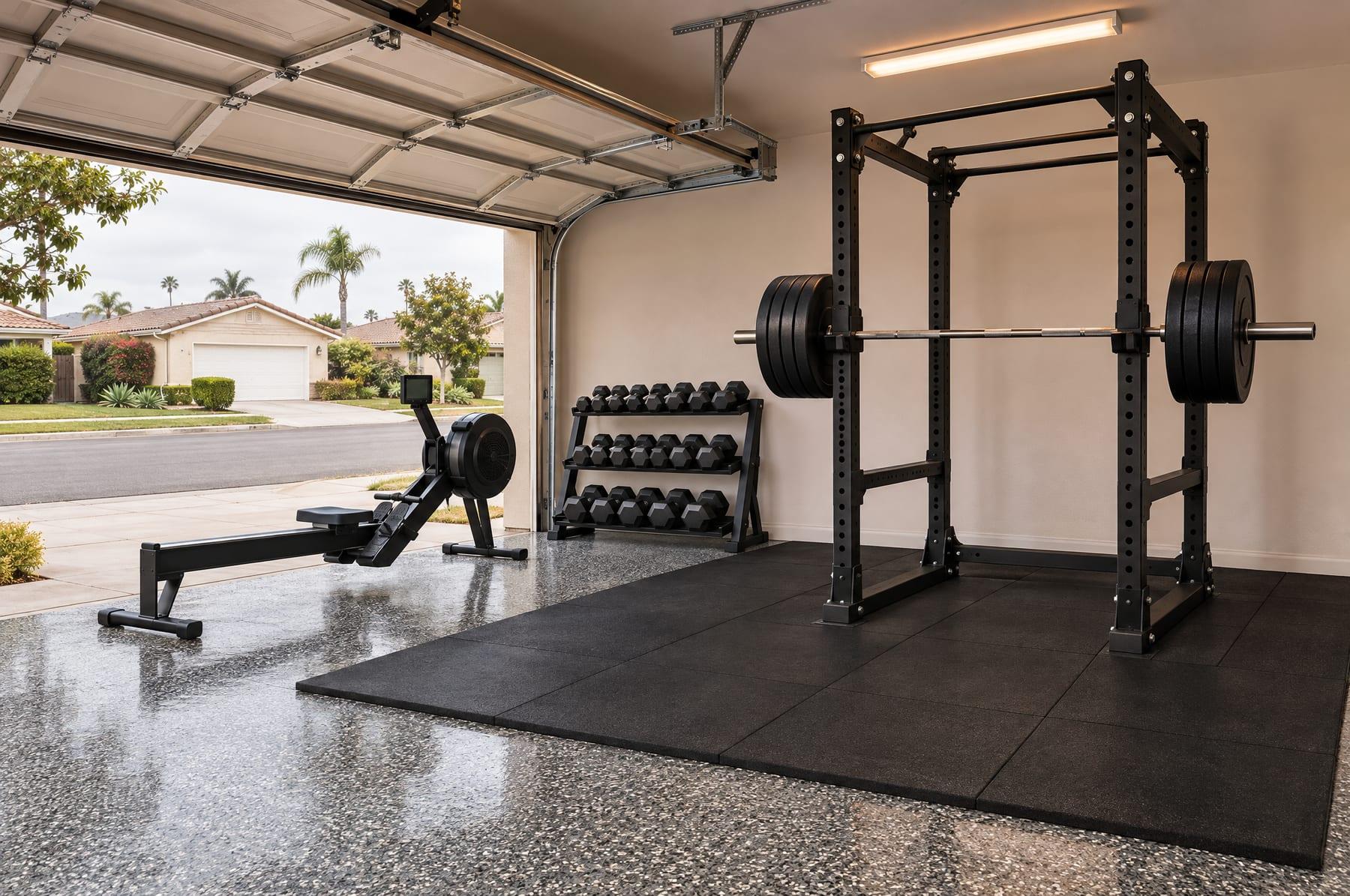
- Home gym. Coat the whole floor, then lay rubber gym tiles where weights get dropped. Rubber takes the impact far better than a hard coating and quiets the room, and the coating handles sweat, chalk and mopping everywhere else.
- Workshop. Chemical resistance and easy cleanup matter more than looks. An epoxy system in a solid color or a light flake blend makes dropped parts easy to find; add a polyaspartic topcoat if the door stays open. Wipe up solvents and brake fluid promptly on any finish.
- Collector or show car. Out of the sun, metallic epoxy gives the most dramatic look. If sun reaches the floor, choose a solid color or fine flake under a polyaspartic topcoat instead. For a car that sits for weeks, a square of plexiglass under each tire guards against plasticizer stains.
- Beach garage with sand. Full flake for grip with wet feet, a polyaspartic topcoat for sand and sun, and a fresh-water rinse after beach days. Test the slab first, and plan the install around the marine layer.
- Rental or ADU. If you own the place, a mid-tone flake blend over a ground slab hides wear between tenants and needs little upkeep. If you are the tenant, tiles or a mat are the floor you can take with you.
Answer five questions for a starting point. Your answers can go straight into an estimate request.
Which coating fits my garage?
01What is the garage mostly for?
02What is the slab like?
03Sun and salt?
04Budget?
05When do you need the garage back?
Answer all five to see which system usually fits, and why. Nothing is sent anywhere until you ask for an estimate.
What "best" doesn't mean
Three shortcuts lead people to the wrong floor.
- The thickest. Film thickness matters, which is why thin kits fail early, but more is not automatically better. Each product is made to go down within a set thickness per coat. A good system is the right thickness of each layer, so ask for the thickness of every coat in writing.
- The most expensive. Metallic epoxy costs the most per square foot and is the wrong choice for a sunny garage. The best value is the system that fits your sun, slab and schedule.
- The longest warranty. A long warranty helps only if you know who stands behind it and what it covers.
How to read a coating warranty
- Who backs it. A manufacturer's material warranty usually covers the product itself, not the labor or the prep. The installer's workmanship warranty covers the install. Ask for both in writing, with names.
- What it leaves out. Ask how tire marks are treated, since data sheets themselves warn that "tire marking may occur." Check too whether moisture from the slab, chemical spills and normal wear are covered.
- What it requires. Ask whether it depends on a moisture test before the install or a care routine afterward, and whether it transfers if you sell the house.
A written estimate that names the products, the prep method, the moisture test and the thickness of each coat says more about how long a floor will last than the length of its warranty. Typical 2027 ranges for each system are in our San Diego cost guide.
Sources and further reading
- ICRI Guideline 310.2R: Selecting and Specifying Concrete Surface Preparation for Sealers, Coatings, Polymer Overlays and Concrete Repair
- ASTM F1869: moisture vapor emission rate using anhydrous calcium chloride
- ASTM F2170: relative humidity in concrete floor slabs using in situ probes
- Sherwin-Williams: epoxy flooring and surface preparation
- Sherwin-Williams: why acid etching is no longer recommended for concrete prep
- Sherwin-Williams: Resuflor Deco Flake RB submittal (UV and tire staining limitations)
- Covestro: polyaspartic coating technology
- Example data sheet: Simiron 1100SL epoxy
- Example data sheet: Sikafloor-264 epoxy
- Example data sheet: Simiron metallic epoxy
- Example DIY kit data sheet: Rust-Oleum EpoxyShield garage floor coating
- Example floor paint data sheet: Rust-Oleum 1-Part Epoxy Floor Paint
- Example sealer data sheet: Foundation Armor AR350 acrylic sealer
- Prosoco: Consolideck PolishGuard data sheet
- Swisstrax: garage floor tiles FAQ
- G-Floor: roll-out garage mat FAQ
Written by Bedrock Epoxy Garage Floors & Concrete Coatings. Prices are typical 2027 San Diego ranges from our cost guide, not quotes. Images are illustrations, not photos of our projects.